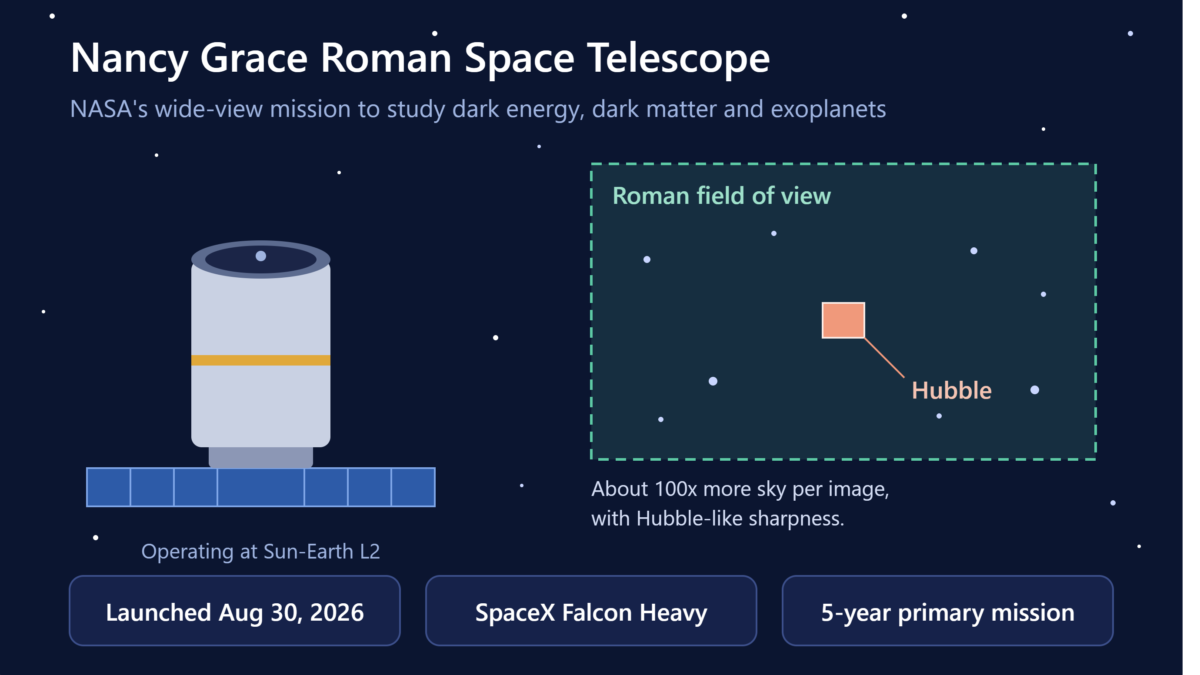
What is the universe made of, and why is it expanding faster and faster? NASA’s Nancy Grace Roman Space Telescope was built to help answer those questions. It launched on a SpaceX Falcon Heavy rocket on August 30, 2026, and is now heading to its final orbit about one million miles from Earth.
This guide explains what the Roman telescope is, how it differs from Hubble, and what scientists hope it will discover.
What Is the Nancy Grace Roman Space Telescope?
The Nancy Grace Roman Space Telescope is a NASA space observatory designed for wide-field surveys of the cosmos. Its main goals are to study dark energy, find exoplanets, and advance infrared astrophysics.
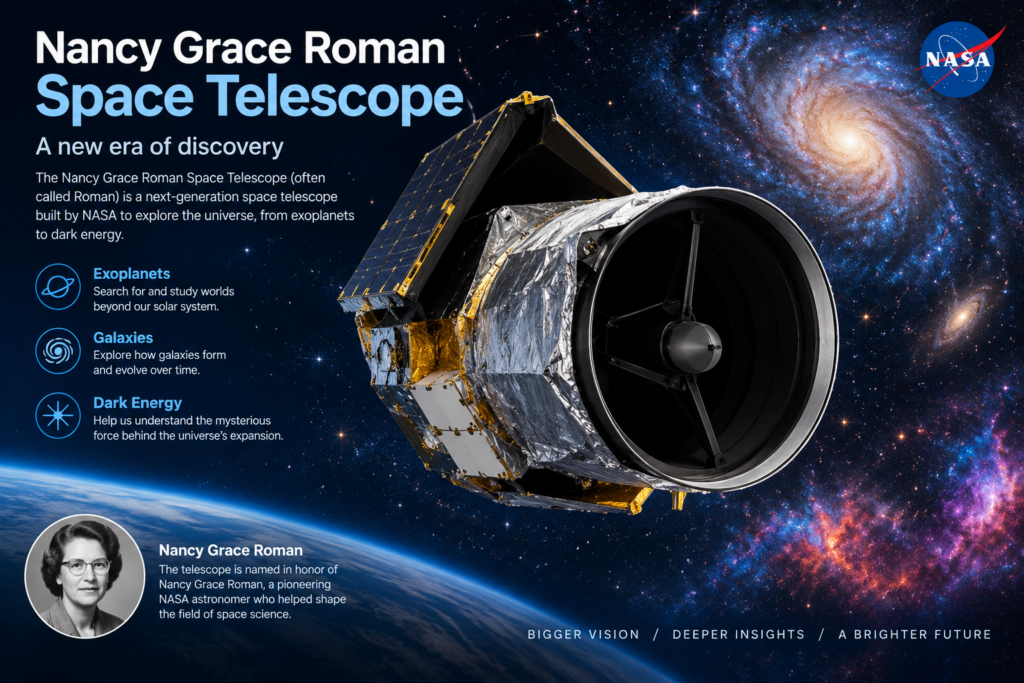
Before it was renamed, the mission was known as WFIRST. NASA named it after Dr. Nancy Grace Roman, the agency’s first chief astronomer. She earned the nickname “Mother of Hubble” for championing the first great space observatories.
When and How Did the Roman Telescope Launch?
- Date: Sunday, August 30, 2026
- Time: 7:26 a.m. EDT
- Rocket: SpaceX Falcon Heavy
- Launch site: Launch Complex 39A, Kennedy Space Center, Florida
The Goddard Space Flight Center ground team began receiving telemetry about seven minutes after liftoff. The rocket released the telescope roughly half an hour into the flight. NASA’s launch overview says the full journey to its operating orbit takes about three months, which includes early checkout of the spacecraft.
Where Is the Roman Telescope Going?
Roman is travelling to the Sun-Earth L2 point, a gravitationally stable spot about one million miles from Earth. The James Webb Space Telescope operates in the same region. From there the telescope has a clear, unobstructed view of the sky.
After arrival, engineers run a commissioning phase to test and calibrate the instruments. Regular science observations begin once that is complete.
Roman vs Hubble: What Is the Difference?
Roman has the same size mirror as Hubble, 2.4 meters. The difference is the camera and the field of view.
| Feature | Hubble | Roman |
|---|---|---|
| Mirror size | 2.4 m | 2.4 m |
| Field of view | Narrow | At least 100x larger |
| Survey speed | Standard | About 1,000x faster |
| Main focus | General astronomy | Dark energy, exoplanets, wide-field surveys |
Roman’s 300-megapixel Wide Field Instrument captures a huge patch of sky in a single image, with Hubble-like sharpness. A good way to picture it: Hubble looks through a small window, while Roman looks out from the whole balcony.
Roman does not replace Hubble or Webb. It is a wide-view partner to them. Hubble and Webb zoom in on specific targets, and Roman finds where the interesting targets are.
What Will Roman Discover?
1. The Mystery of Dark Energy
Dark energy is the unknown force that appears to be speeding up the expansion of the universe. Roman will map how matter is spread across the cosmos and measure how much the universe has expanded over time. That gives scientists new ways to test competing explanations.
2. Clues About Dark Matter
Dark matter is invisible material that holds galaxies together through gravity. By surveying huge numbers of galaxies, Roman will give researchers a large dataset for studying how dark matter is distributed.
3. Thousands of New Exoplanets
Roman will find planets around other stars in two ways:
- Gravitational microlensing: When a star or planet passes in front of a distant star, gravity bends and magnifies the background light. Roman will monitor hundreds of millions of stars this way. Projections run from over a thousand to roughly 2,600 new planets, including many rocky worlds.
- Transit method: ESA says Roman could also detect a very large number of planets, potentially more than 100,000, as they pass in front of their stars.
These numbers are projections. The real totals will only be known after the mission.
4. The Coronagraph Instrument
Roman carries a coronagraph that blocks a star’s glare so scientists can see faint planets nearby. It is a technology demonstration that prepares the way for the future Habitable Worlds Observatory, which will search for signs of life on Earth-like planets.
Quick Facts About the Roman Space Telescope
- It is about the size of a tour bus.
- It is the first NASA space telescope fitted with a grapple fixture, so a future mission could capture it for servicing.
- The primary mission lasts five years, with the possibility of an extension.
- Reported cost is about $4.3 billion.
Frequently Asked Questions
When did the Nancy Grace Roman Space Telescope launch?
On August 30, 2026, aboard a SpaceX Falcon Heavy from Kennedy Space Center, Florida.
What is the Roman Space Telescope designed to do?
It studies dark energy and dark matter, finds exoplanets, and carries out wide-field infrared surveys of the sky.
How is Roman better than Hubble?
It has a field of view at least 100 times larger and can survey the sky about 1,000 times faster. It complements Hubble rather than replacing it.
Where is the Roman Space Telescope now?
It is travelling to, or settling at, the Sun-Earth L2 point, about one million miles from Earth.
When will Roman’s first images be released?
Science images follow the commissioning phase. Check NASA’s official Roman page for announcements.
Why is it named after Nancy Grace Roman?
She was NASA’s first chief astronomer and a leading advocate for space-based telescopes, including Hubble.
Conclusion
The Nancy Grace Roman Space Telescope gives astronomers a much wider view of the universe, a faster way to survey it, and a real chance to find thousands of new worlds. Over the next few years, expect Roman to change how we think about dark energy, dark matter and planets beyond our solar system. Bookmark this page for updates as the first science images arrive.