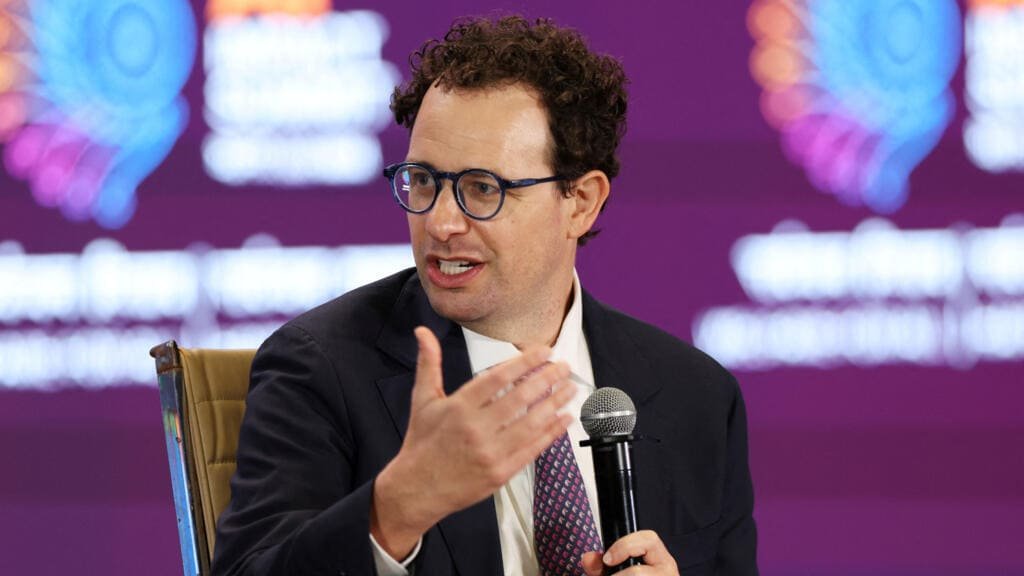
Dario Amodei is the co-founder and CEO of Anthropic, the AI company behind the Claude models. A former physicist and neuroscience researcher, he went on to help build some of the most influential systems in modern machine learning, and then left OpenAI to start a lab built around AI safety. In 2026 he is one of the most closely watched figures in technology, with Anthropic valued at $965 billion and an IPO reportedly in preparation.
This guide covers who Dario Amodei is, his education, career path, net worth, key essays, and the controversies and debates around his leadership.
Dario Amodei at a Glance
| Detail | Information |
|---|---|
| Full name | Dario Amodei |
| Born | 1983, San Francisco, California, USA |
| Age (2026) | 43 |
| Role | Co-founder and CEO of Anthropic |
| Education | Stanford University (BS, physics); Princeton University (PhD, biophysics) |
| Previous roles | Vice President of Research at OpenAI; Senior Research Scientist at Google Brain; research at Baidu |
| Known for | Co-inventing reinforcement learning from human feedback (RLHF), leading GPT-2 and GPT-3 research, founding Anthropic |
| Spouse | Camilla Clark (married 2022) |
| Sibling | Daniela Amodei, president of Anthropic |
| Net worth | About $15.5 billion (Forbes estimate) |
Who Is Dario Amodei?
Dario Amodei is an American AI researcher and entrepreneur who serves as the CEO of Anthropic, a public benefit corporation focused on building AI systems that are steerable, interpretable and safe. He co-founded the company in 2021 with his sister, Daniela Amodei, and several other former OpenAI colleagues.
What sets him apart from many tech founders is that he writes publicly and at length about both the promise and the danger of advanced AI. His essays are read by policymakers, engineers and investors alike, and his warnings about job losses, misuse and concentrated power have shaped the public debate.
Early Life and Education
Dario Amodei was born in San Francisco in 1983, four years before his sister Daniela. His father, Riccardo Amodei, was an Italian-American leather craftsman, and his mother, Elena Engel, was a project manager who worked on library projects. Amodei has said that his father’s death from hepatitis C, shortly before an effective cure arrived, is one reason he cares so much about AI-accelerated medical research.
He attended Lowell High School in San Francisco and was a member of the US Physics Olympiad team in 2000. He began university at Caltech, then transferred to Stanford University, where he earned a bachelor’s degree in physics.
For graduate study he moved to Princeton University, where he completed a doctorate in biophysics as a Hertz Fellow. His thesis examined how large networks of neurons behave collectively. He then worked as a postdoctoral scholar at the Stanford University School of Medicine. This neuroscience background still shapes how he thinks about AI: as a complex system that must be measured, understood and interpreted.
Dario Amodei’s Career Before Anthropic
Baidu and Google Brain
Amodei began working in AI in the mid-2010s. He spent about a year at Baidu, where his team worked on speech recognition, and then joined Google Brain as a senior research scientist. In 2016 he co-authored the widely cited paper Concrete Problems in AI Safety, which helped define the research agenda for the field.
OpenAI
Amodei joined OpenAI in 2016 and rose to Vice President of Research. In that role he set research direction and led the work behind the GPT-2 and GPT-3 language models. He is also credited as a co-inventor of reinforcement learning from human feedback (RLHF), the training method that helps AI models follow human preferences and is now used across the industry.
By the end of 2020, he and several colleagues had developed different views from OpenAI’s leadership about how fast to scale and how seriously to prioritize safety. They left to start something new.
Founding Anthropic
In 2021, Dario and Daniela Amodei founded Anthropic with other senior ex-OpenAI researchers. The founding team included Jared Kaplan, Sam McCandlish, Tom Brown, Chris Olah and Jack Clark. Together they built the company around three ideas: AI systems should be reliable, interpretable and steerable.
Anthropic is best known for the Claude family of AI models, and it has become one of the leading frontier AI labs. If you want to understand the company itself, read our overview of Anthropic and its mission or our explainer on Claude AI.
In November 2023, during the turmoil at OpenAI, that company’s board reportedly approached Amodei about replacing Sam Altman and possibly merging the two companies. He declined both offers.
Anthropic’s Valuation and the IPO
Anthropic’s growth has been remarkable. In May 2026 the company raised $65 billion in a Series H round at a $965 billion post-money valuation. In October 2026, details of the company’s planned public offering emerged, including executive pay and risk disclosures. According to Fortune, Amodei received about $17.96 million in total compensation in 2025, including a salary of roughly $654,000.
Like any IPO of this size, the process has drawn scrutiny. New York City’s comptroller wrote to the company in October asking it to address safety and governance questions before proceeding.
Dario Amodei Net Worth
Forbes estimates Dario Amodei’s net worth at about $15.5 billion, placing him among the world’s wealthiest people and at number 75 on the 2026 Forbes 400 list. His fortune comes almost entirely from his stake in Anthropic. Fortune’s analysis of the company’s filing puts the value of his roughly 240 million shares at about $14 billion at the price referenced in the filing, with the figure potentially doubling if the company reached a $2 trillion valuation.
These numbers are estimates and will move sharply once shares begin trading. Amodei and his co-founders have also publicly pledged to give away most of their wealth, and some of his shares already sit in donor-advised funds.
Dario Amodei’s Key Essays and Ideas
Machines of Loving Grace (October 2024)
In this essay, Amodei laid out an optimistic vision of what powerful AI could do if its risks are managed: faster progress in biology and medicine, better mental health treatment, economic development, and more. He argued that most people underestimate both how large the upside could be and how serious the risks are. The essay also makes the case that democracies should keep the lead in AI.
The Adolescence of Technology (January 2026)
His follow-up essay focuses on danger. He describes five categories of risk: autonomous AI systems acting against human interests, misuse for mass destruction (especially biological weapons), misuse by powerful actors to seize or entrench political power, large-scale economic disruption, and unpredictable indirect effects. He has warned that AI could displace a large share of entry-level white-collar jobs within a few years.
The Call to Slow Down (September 2026)
In September 2026, Amodei urged leading AI labs to slow capability gains, coordinate on safety and open their systems to outside auditors. Executives at rival companies were reported to have voiced early support, which made the call one of the most discussed AI policy moments of the year.
The Pentagon Dispute
One of the most prominent episodes of his tenure began in February 2026, when Amodei refused to drop contractual limits on using Claude for mass domestic surveillance or fully autonomous weapons. The US Department of Defense then labeled Anthropic a supply-chain risk, and the administration ordered federal agencies to stop using its technology. Anthropic challenged the decision in court, and on March 26, 2026 a federal judge issued a temporary injunction, saying the government’s actions appeared to be First Amendment retaliation. The dispute remains a defining example of how AI companies balance safety commitments against government demands.
Awards and Recognition
- Named to the TIME 100 Most Influential People list in 2025 and again in 2026 (alongside Daniela Amodei)
- Included among the “Architects of AI” named TIME’s Person of the Year in 2025
- Hertz Foundation Fellow (2007) and Hertz Thesis Prize winner (2011)
- Ranked on the Forbes 400 in 2026
Personal Life
Amodei began dating Camilla Clark in 2014 and the two married in 2022. He lives in San Francisco, the city where he grew up. He keeps a relatively private personal profile compared with many tech CEOs, and prefers to share his views through long-form essays, interviews and podcasts.
Where to Learn More From Dario Amodei
His official website, darioamodei.com, collects his essays, short posts, op-eds and interviews. Those include appearances on the Lex Fridman Podcast, the Dwarkesh Podcast, The Ezra Klein Show and others, plus opinion pieces on AI transparency and export controls.
Final Thoughts
Dario Amodei’s story runs from physics labs and neuroscience to the center of the global AI race. Whether you see him as a cautious builder, a persuasive warning voice, or both, his decisions and writing will continue to influence how advanced AI is developed and governed. Bookmark this page, as we update it when major news about him or Anthropic breaks.