What Is a ZIP+4 Code?
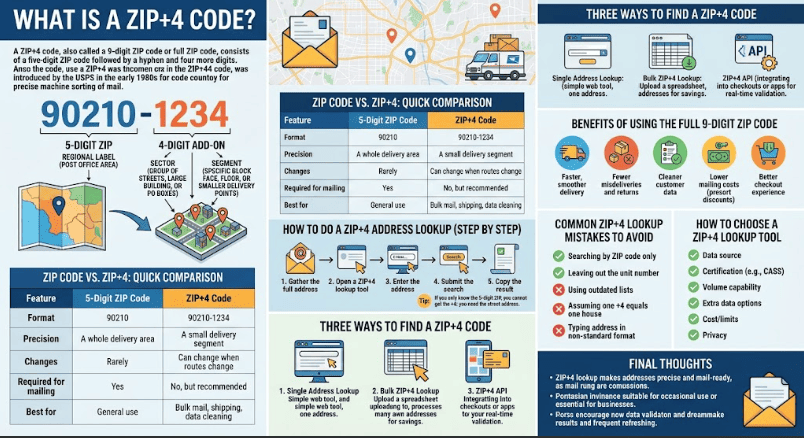
A ZIP+4 code, also called a 9-digit ZIP code or full ZIP code, is a five-digit ZIP code followed by a hyphen and four more digits. The United States Postal Service (USPS) introduced the format in the early 1980s so mail could be sorted more precisely by machine.
The five-digit part works like a regional label. The four-digit part narrows it down to a small slice of a mail carrier’s route. Depending on the area, that slice might be one side of a street, a group of apartments, one floor of a large building, or a single busy business.
What the Last 4 Digits of a ZIP Code Mean
The add-on is made of two parts, each two digits long:
- The first two digits (sector or segment): a group of streets, a large building, or a set of PO boxes.
- The last two digits (segment): a specific block face, a floor, or a smaller set of delivery points inside that sector.
Together they identify a delivery segment rather than one exact house. Several neighbors can legitimately share the same ZIP+4 code.
ZIP Code vs. ZIP+4: Quick Comparison
| Feature | 5-Digit ZIP Code | ZIP+4 Code |
|---|---|---|
| Format | 90210 | 90210-1234 |
| Precision | A whole post office delivery area | A small delivery segment |
| Changes | Rarely | Can change when routes are reorganized |
| Required for mailing | Yes | No, but recommended |
| Best for | General use | Bulk mail, shipping, data cleaning |
A common misunderstanding is that ZIP codes are neat map boundaries. They are not. They are built around delivery routes, so a ZIP code can cross city, county and even state lines.
How to Do a ZIP+4 Address Lookup (Step by Step)
Finding a full ZIP code takes under a minute when you have the street address.
- Gather the full address. You need the street number, street name, and city and state. If the address has an apartment, suite or unit number, include it, because it can change the +4 result.
- Open a ZIP+4 lookup tool. The USPS offers a free ZIP code lookup on its own website, and several address-verification companies run free demo tools.
- Enter the address in the fields. Use the correct spelling and avoid nicknames for streets.
- Submit the search. The tool compares your input with the postal database and corrects small errors such as a missing street suffix.
- Copy the result. The nine-digit code appears at the end of the standardized address.
Tip: If you only know the five-digit ZIP, you usually cannot get the +4 from it alone. One ZIP code can contain tens of thousands of different ZIP+4 segments, so the street address is what makes the lookup accurate.
How to Look Up a PO Box ZIP+4
PO boxes work the same way. Enter “PO Box 123” in the street field, then add the city and state. In most cases each PO box is given its own +4, and it often lines up with the box number.
Three Ways to Find a ZIP+4 Code
1. Single Address Lookup
This is the simplest option and perfect for a one-time need, such as filling in a shipping form or a bank application. Use a free web tool, type the address and read the result.
2. Bulk ZIP+4 Lookup
Businesses with mailing lists, customer databases or e-commerce orders often need thousands of codes at once. A bulk lookup lets you upload a spreadsheet or CSV file, processes every row, and returns the same list with the +4 added.
This is also where the real savings are. Mailers that presort and add accurate ZIP+4 codes and barcodes may qualify for commercial postage discounts that are not available to the casual sender.
3. ZIP+4 API
Developers can add a ZIP+4 lookup directly into a checkout page, CRM or app. An API checks each address in real time and returns the standardized address with its nine-digit ZIP. This stops bad data at the entry point rather than cleaning it later.
Why a Good ZIP+4 Lookup Also Validates the Address
A reliable lookup does more than guess four numbers. Before it can assign a +4, the tool has to confirm that the address actually exists as a deliverable point. That process usually includes:
- Address standardization: converting “Street” to “St,” fixing capitalization, and putting parts in postal order.
- Address validation: checking the address against official postal data.
- Delivery point validation (DPV): confirming the address can receive mail at that exact point.
If you want to understand this layer better, read our guide to address verification and why it matters. It explains how standardization and validation work together.
Many providers also return extras with the ZIP+4, such as county, latitude and longitude, time zone, and whether the address is residential or commercial. Those details are useful for analytics, delivery planning and customer segmentation.
Benefits of Using the Full 9-Digit ZIP Code
Using ZIP+4 is optional, but the advantages are practical:
- Faster, smoother delivery. The extra digits help sorting machines route a letter closer to the final carrier, which reduces manual handling.
- Fewer misdeliveries and returns. Because the address was validated to produce the code, it is less likely to bounce back.
- Cleaner customer data. Standardized addresses make it easy to spot duplicates and merge records.
- Lower mailing costs. Direct-mail teams that meet USPS requirements can unlock presort discounts.
- Better checkout experience. Address lookup at checkout means fewer typos, fewer failed deliveries and fewer abandoned carts.
To compare lookup options for your website or business, see our overview of ZIP code lookup by address.
How Accurate and Up to Date Is a ZIP+4 Lookup?
The four-digit add-on is more fluid than the five-digit ZIP. New construction, route changes and staffing adjustments can all lead the USPS to reassign segments. Some address-data providers estimate that a noticeable share of addresses see their +4 change in any given month.
For that reason:
- Prefer tools that use current USPS data, such as CASS-certified software.
- Re-check saved addresses regularly instead of trusting an old spreadsheet.
- For anything high-value, such as a large mailing, validate the list shortly before sending.
To learn more about how official validation works, visit our explanation of USPS address validation.
Common ZIP+4 Lookup Mistakes to Avoid
- Searching by ZIP code only. The +4 depends on the street address, not the five-digit code.
- Leaving out the unit number. Apartment and suite numbers can place two neighbors in different segments.
- Using outdated lists. A +4 that was correct last year may have changed.
- Assuming one +4 equals one house. It often covers a handful of delivery points.
- Typing the address in a non-standard format. Misspellings and missing directions (N, S, E, W) can cause a failed match.
How to Choose a ZIP+4 Lookup Tool
When you compare tools, check these points:
- Data source: does it use official USPS data and how often is it updated?
- Certification: CASS certification shows the software meets USPS accuracy standards.
- Volume: can it handle one address, a bulk file, or live API traffic?
- Extra data: do you need geocodes, county or residential/commercial flags?
- Cost and limits: free demos are fine for occasional use, while businesses usually need a paid plan.
- Privacy: make sure you understand how submitted addresses are stored.
Final Thoughts
A ZIP+4 address lookup is a fast way to turn an ordinary address into a precise, mail-ready one. For a single package, a free tool is all you need. For mailing lists, customer databases and online stores, combine the lookup with full address validation and refresh your data often.
Follow the steps above, avoid the common mistakes, and you will get the right nine-digit ZIP code every time.