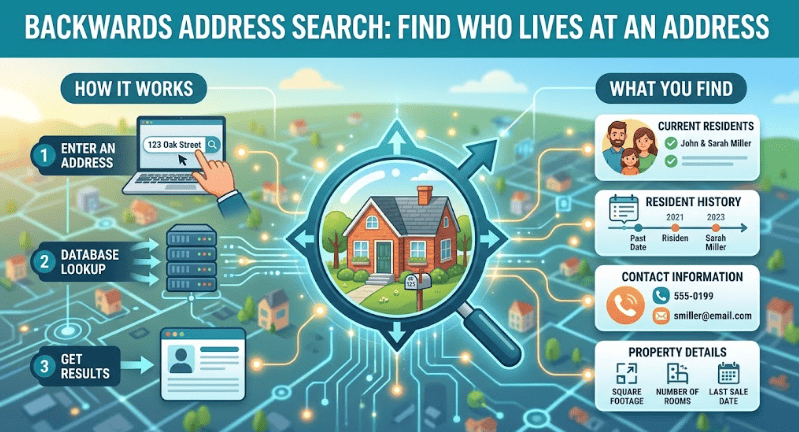
You have a street address, but no name. Maybe a package arrived at the wrong door, an old friend moved, or you want to check a property before you buy. A backwards address search helps in exactly this situation. Instead of searching for a person to find their address, you start with the address and work backwards to the owner, the resident, or the property details.
In this guide, you’ll learn how a backwards address search works, which methods are free, what information you can realistically expect, and how to stay within the law.
What Is a Backwards Address Search?
A backwards address search (also called a reverse address lookup or reverse address search) is the process of using a physical address to find information connected to it. Depending on the source, that can include:
- The name of the property owner
- The name of a current or past resident
- Property details such as lot size, building type, and tax value
- Whether the address belongs to a home or a business
It is the opposite of a normal address search. A normal search asks, “Where does this person live?” A backwards address search asks, “Who is connected to this location?”
How Does a Backwards Address Search Work?
Behind the scenes, these searches pull from records that already exist in separate places:
- Public property records. Local governments record who owns a parcel of land and what it is worth.
- Tax and assessor data. County offices keep ownership and valuation details for tax purposes.
- Business registrations. If a company operates from the address, state filings may list it.
- Commercial databases. People search websites combine many public sources into one searchable page.
Accuracy depends on how recent the source is. Property ownership changes when a sale is recorded, while residents can move without any public record updating quickly. Treat any result as a lead to confirm, not as a final answer.
Free Ways to Do a Backwards Address Search
You don’t always need a paid tool. Start with these.
1. Check the county assessor or recorder website
Most US counties publish property search pages. Enter the street address and you can often see the owner’s name, the mailing address, and the assessed value. This is usually the most reliable free source because it comes straight from the government record.
2. Use a search engine
Type the full address in quotation marks. If the address belongs to a business, a listing, or a public notice, it often appears in the results. This works best for commercial addresses.
3. Look at mapping and street view tools
Digital maps can show whether an address is a house, an apartment building, or a shop. A business sign or a listed company name can answer your question in seconds.
4. Try property listing portals
Real estate sites often show sale history, property type, and sometimes the listing agent. This helps if the address was recently sold or is for sale.
5. Verify the address itself
Before you search further, make sure the address is valid. Postal service address lookup tools confirm that a street, unit number, and ZIP code are written correctly. Many failed searches come from a small typo.
Paid Reverse Address Lookup Services
People search websites let you type an address and return names, ages, possible relatives, and phone numbers. They save time because they gather records in one place.
Before you pay, keep these points in mind:
- Results can be outdated. Always cross-check with a government record.
- “Free” often means a preview. Full details are usually behind a subscription.
- Read the terms. Reputable services state what you may and may not use the data for.
What Information Can You Actually Find?
| Information | How likely | Best source |
|---|---|---|
| Property owner’s name | High | County assessor or recorder |
| Property value and tax details | High | County assessor |
| Current resident’s name | Medium | People search sites, mail records |
| Phone number or email | Low to medium | Commercial databases (accuracy varies) |
| Business at the address | Medium | State business registry |
Renters and new residents are harder to find than owners, because a lease usually creates no public record.
Common Reasons People Use a Backwards Address Search
- Reconnecting with a friend or relative whose contact details changed
- Buying or renting and wanting to confirm who owns the property
- Sending a legal notice or mail to the right person
- Checking a business or a seller before a transaction
- Resolving a neighbor or property line question
- Cleaning a mailing list and confirming that addresses are linked to the right records
Is a Backwards Address Search Legal?
In the United States, looking up public property records is generally legal, because those records are public by design. The limits come from how you use the information.
- Under the Fair Credit Reporting Act (FCRA), certain reports can’t be used to decide employment, tenant screening, insurance, or credit unless the provider is a regulated consumer reporting agency.
- Using someone’s address to harass, stalk, or intimidate them is illegal, whatever tool you used to find it.
- Privacy laws differ by country and state, so check the rules where you and the other person live.
If your reason is something sensitive, such as a dispute, safety concern, or legal matter, speak to a lawyer or contact the authorities. Don’t confront anyone yourself.
How to Protect Your Own Address From Lookups
The same tools that help you can expose you. To reduce your own exposure:
- Search for your own address and see what appears.
- Request removal from people search sites. Most have an opt-out form.
- Use a P.O. box or business address for public listings and registrations where allowed.
- Limit what you share on social media and online forms.
- Check your county’s rules. Some regions let certain residents shield property records.
For more on staying safe online, read our guide on Internal Link 1: how to remove your personal information from people search sites.
Tips for Better Results
- Write the address in full, with the unit or apartment number.
- Try common spelling variations of the street name.
- Compare at least two sources before trusting a name.
- Keep records of where you found the information.
- If you also have a phone number, our article on Internal Link 2: reverse phone lookup explains how to trace it.
- For official ownership searches, see Internal Link 3: how to find public records online.
Frequently Asked Questions
What is the difference between a backwards address search and a reverse address lookup?
They mean the same thing. Both start with an address and return details about the property, owner, or resident. “Reverse address lookup” is the more common term.
Can I do a backwards address search for free?
Yes. County assessor and recorder websites are free in most areas and show owner and property details. Paid sites add resident names and contact details.
Can I find out who lives at an address?
Sometimes. Owners are easy to find through public records. Renters are harder, because their names are often not recorded publicly.
How accurate are reverse address lookups?
Government records are the most accurate but can lag behind recent sales. Commercial databases may be incomplete or outdated, so verify any result.
Is it legal to look up who owns a property?
In the US, yes, property ownership records are generally public. What you do with the information is what the law regulates.
Can I remove my address from these websites?
Often yes. Most people search sites offer an opt-out request, though you may need to repeat it on each site.
Final Thoughts
A backwards address search turns a plain street address into useful information: who owns the property, what it is worth, and sometimes who lives there. Start with free county records, confirm the details with a second source, and use paid tools only when you need more. Above all, use what you find responsibly and respect people’s privacy.