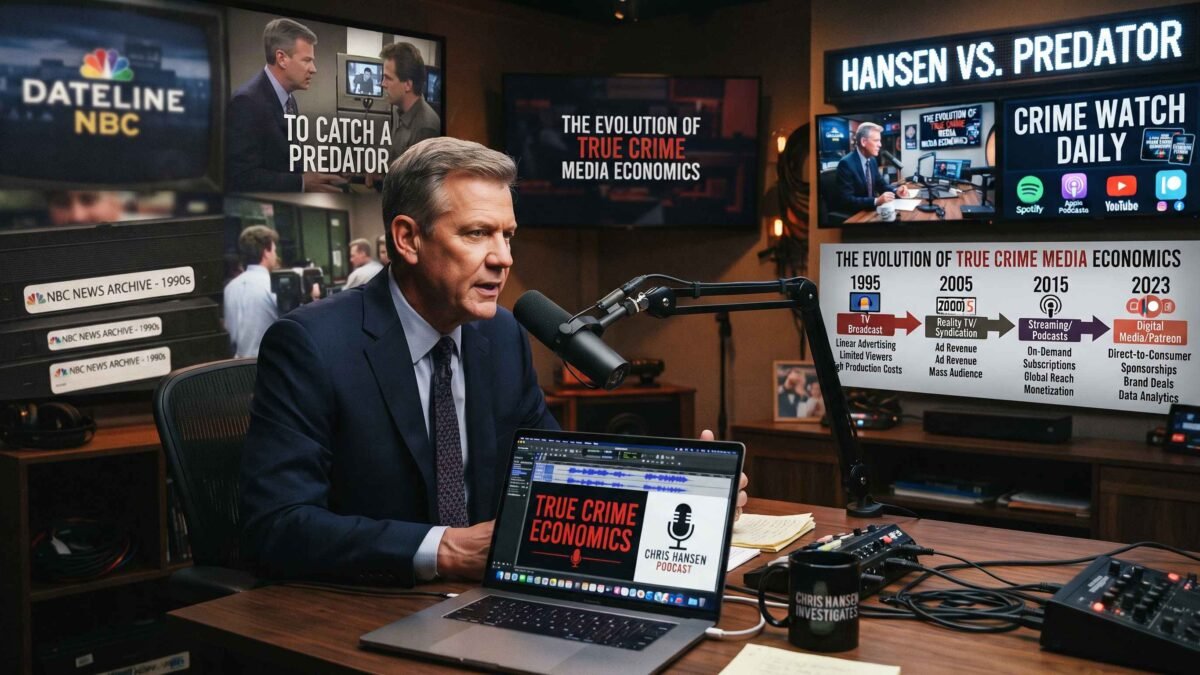

Few people have watched the business of true crime change from the inside the way Chris Hansen has. He started as a network correspondent with a huge budget behind him. Then he asked strangers on the internet to fund his next sting. Today he runs his own streaming service and YouTube channel. His career is basically a 20-year case study in true crime media economics, and every stage holds a lesson about who pays for investigative journalism and why.
This guide breaks down each era of Hansen’s career as a business model. It covers what worked, what failed, and what modern YouTubers, podcasters and indie journalists can take from it in 2026, the year Hollywood turned his story into a movie.
Quick Summary
- Network era (2004–2013): To Catch a Predator was a ratings hit for Dateline NBC, but advertiser worries and lawsuits ended it in 2007.
- Crowdfunding era (2015): A Kickstarter for Hansen vs. Predator aimed for about $400,000 and raised roughly $89,000.
- Syndication era (2016–2018): The show was sold to Crime Watch Daily, which boosted that program’s ratings.
- Creator era (2019–now): YouTube, a weekly podcast and his own subscription streamer, TruBlu.
- Big lesson: Investigative journalism rarely pays for itself. Owning your audience and spreading revenue across several channels is what keeps it alive.
Why Investigative Journalism Has Always Had a Money Problem
Before looking at Hansen, it helps to understand the basic economics. Investigative reporting is slow, legally risky and expensive. One story can take months of research, travel, cameras, lawyers and security. Yet the final product often earns the same ad money as a cheap celebrity story.
Journalism researcher James Breiner made this point in a 2016 paper on the economics of accountability journalism. He argued that this kind of reporting has never truly paid for itself. Advertising or government support always covered the cost, so nobody really knows what audiences would pay for it on its own. Once print ads collapsed, newsrooms cut investigative teams first.
True crime is the exception that proves the rule. It is one of the few forms of investigative content that audiences will actively seek out, binge and even pay for. That is why the genre became a test lab for new business models, and why Chris Hansen’s career is so useful to study.
Era 1: The Network Ratings Machine (2004–2007)
How To Catch a Predator Made Money
Hansen joined NBC News in 1993 and spent years on serious investigations for Dateline NBC, from airport security to terrorism. His breakout, though, came from To Catch a Predator, which aired from 2004 to 2007. Working with the online watchdog group Perverted-Justice, the show used adult decoys posing as minors in chat rooms. The men who showed up at a “sting house” found Hansen and a camera crew instead.
Commercially, it was a home run. According to Nielsen figures cited by Forbes, the segment averaged a little over 7 million viewers and lifted Dateline‘s overall series average by about 13%. NBC quickly launched spin-offs such as To Catch a Con Man and To Catch an I.D. Thief, and Hansen published a book in 2007.
The economic logic was simple:
- Low cost per hour: One sting house could produce several episodes of footage.
- Repeatable format: Same setup, new city, new suspects.
- Built-in drama: A clear hero, a clear villain and a confrontation every few minutes.
- Catchphrase branding: “Why don’t you have a seat?” became a pop culture meme, which is free marketing.
Why To Catch a Predator Was Canceled
The same features that made the show profitable also made it risky. In 2006, a Texas prosecutor targeted in a sting in Murphy, Texas, took his own life as police and cameras arrived at his home. His family sued NBC, and a federal judge later criticized the network for crossing from journalism into reckless interference with police work. Critics also questioned whether paying a vigilante group and coordinating with police turned reporters into participants.
Advertisers grew nervous, rival networks started asking hard questions, and the franchise ended in 2007. NBC did not renew Hansen’s contract in 2013, closing a 20-year run.
Economic lesson: A network can fund expensive investigations, but it can also pull the plug the moment a story becomes a brand risk. When the money comes from advertisers, the advertisers’ comfort level sets the editorial limits.
Era 2: The Crowdfunding Experiment (2015)
The Hansen vs. Predator Kickstarter
Without a network, Hansen tried a direct-to-fan model. In April 2015 he launched a Kickstarter campaign for Hansen vs. Predator, a reboot that would stream online while he looked for a TV buyer. The goal was around $400,000. Rewards included T-shirts, mugs, signed items and, at the $150 tier, a personal voicemail greeting recorded by Hansen himself.
The campaign raised roughly $89,000 from about 1,200 backers, far short of the target. Even so, his team carried out what was described as the first crowdfunded sex sting, in Fairfield, Connecticut, with support from local police. Ten men were caught.
Where Crowdfunding Went Wrong
The trouble came after the money arrived. Backers complained for years that promised rewards never showed up. In January 2019, Hansen was charged in Connecticut over checks, worth about $13,000, that bounced with a vendor supplying promotional merchandise. The charges were later dropped, but the reputational damage stuck.
Economic lesson: Crowdfunding sells a promise. Investigative work is unpredictable, while physical rewards are a fixed logistics bill. When the budget is short, merchandise costs eat into the journalism, and unhappy backers become your loudest critics. Fan funding works best for recurring, digital-first rewards, not one-time physical gifts.
Era 3: Selling the Format to Syndication (2016–2018)
The Hansen vs. Predator footage found a home when the broadcast rights were sold. In September 2016, Hansen became host of the syndicated show Crime Watch Daily, with Hansen vs. Predator as a recurring segment. His arrival lifted the program’s household ratings by about 20%, with a stronger gain among women aged 18 to 34. The show was renewed for a third season and ended in 2018.
Economic lesson: A proven format is a sellable asset. Even after the crowdfunding stumble, the brand and the footage had licensing value. For creators, this is the idea of building a format, not just a video, so it can be licensed, syndicated or sold later.
Era 4: The Creator Economy and Owned Media (2019–Now)
Chris Hansen’s YouTube Channel and Podcast
In October 2019, Hansen launched a YouTube channel called Have a Seat with Chris Hansen, featuring weekly interviews and investigations, including a widely followed look into a controversial YouTuber. By 2026, his channel had more than 680,000 subscribers and over 46 million total views. Since 2020 he has also hosted Predators I’ve Caught, a weekly podcast that revisits old cases with updates and listener questions.
This is a smart, low-cost move. His archive of past investigations becomes fresh content. Podcasts and YouTube create ad revenue and, more importantly, an audience he controls instead of renting from a network. If you follow how creators turn big view counts into a business, our YouTube Trends coverage tracks the channels and formats getting the most attention right now.
TruBlu: A True Crime Streaming Service of His Own
The biggest shift came with TruBlu, a true crime streaming service Hansen co-founded with filmmaker Shawn Rech of Transition Studios. Rech saw an opening when networks cancelled cop shows in 2020. TruBlu launched in 2022 and was priced at about $4.99 a month at launch, with monthly and yearly plans available on its app and on devices like Roku, Fire TV and Apple TV.
TruBlu’s flagship is Takedown with Chris Hansen, a return to predator investigations, this time working closely with local law enforcement. Hansen has said streaming gives him far more creative control than network TV ever did. In February 2026, the service premiered Dangerous Games: Investigating Roblox, a Hansen special on child safety in online gaming, a topic already trending with younger audiences.
Economic lesson: Subscriptions solve the problem that ended To Catch a Predator. When viewers pay directly, advertisers can’t cancel the show over a controversy. The trade-off is that a niche streamer must constantly win and keep subscribers, which is why marketing matters as much as reporting.
Era 5: Hollywood Turns the Story Into a Product (2025–2026)
Hansen’s story now has value as entertainment in its own right. The 2025 documentary Predators examined the legacy of the original show and the copycat sting channels it inspired. Then, on September 25, 2026, A24 released Primetime, a drama directed by Lance Oppenheim with Robert Pattinson playing Hansen. The film is loosely based on the rise of To Catch a Predator and the ethical questions around it.
Here is the clever business twist. According to Cord Cutters News, TruBlu bought advertising slots before showings of Primetime to promote the real Hansen’s current work. A movie about his past became a marketing channel for his present business. That is a textbook example of turning attention into subscribers.
Chris Hansen’s Revenue Model at a Glance
| Era | Main Money Source | Who Controlled It | Biggest Risk |
|---|---|---|---|
| Dateline NBC (2004–2013) | Network advertising | NBC | Advertiser pullback, lawsuits |
| Kickstarter (2015) | Fan pledges | Hansen | Underfunding, reward delivery |
| Crime Watch Daily (2016–2018) | Licensing / syndication | Distributor | Show cancellation |
| YouTube and podcast (2019–now) | Ads, sponsors, views | Hansen (on rented platforms) | Platform rules and demonetization |
| TruBlu (2022–now) | Subscriptions | Hansen and partners | Subscriber growth and churn |
7 Lessons on Monetizing Investigative Journalism
Whether you run a true crime YouTube channel, a podcast or a small news site, these are the takeaways that matter most.
- Diversify your income. Hansen survived because he never relied on one source for long. Combine ads, sponsors, memberships and licensing.
- Own the audience, not just the content. Email lists, apps and subscriptions protect you when a platform or network changes its mind.
- Build formats, not one-offs. A repeatable format like the sting house can be sold, licensed and revived years later.
- Turn your archive into new revenue. Old cases became a podcast and YouTube episodes. Your back catalog is an asset.
- Under-promise on crowdfunding. Offer digital rewards you can deliver fast. Physical merch can sink a small budget.
- Ethics is a financial issue. The scandal that ended To Catch a Predator cost far more than any single episode earned. Work with legal advice and, where needed, law enforcement.
- Ride the trend wave. TruBlu advertising alongside Primetime shows how to turn a viral moment into lasting subscribers.
The same playbook shows up far outside true crime. When a creator’s travel or religious vlog suddenly pulls millions of views, as in Mr. Faisu’s Madina vlog, the real business question is the same one Hansen faced: how do you