Huawei is one of the biggest names in the electric car world, yet it does not own a single car factory. Its founder has publicly promised more than once that Huawei will not become a carmaker. Even so, cars carrying Huawei technology have passed 1.5 million deliveries in China. The secret behind this is Huawei HIMA, a new kind of partnership that lets Huawei shape the car without building it.
In this guide, we explain what Huawei HIMA is, how its business model works, which car brands are part of it, how well it is selling in 2026, and why this model could change the global car industry.
Key Takeaways
- HIMA stands for Harmony Intelligent Mobility Alliance, a car alliance led by Huawei.
- Huawei does not manufacture cars. Partner automakers build them, while Huawei provides software, AI driving systems, design input, marketing and sales channels.
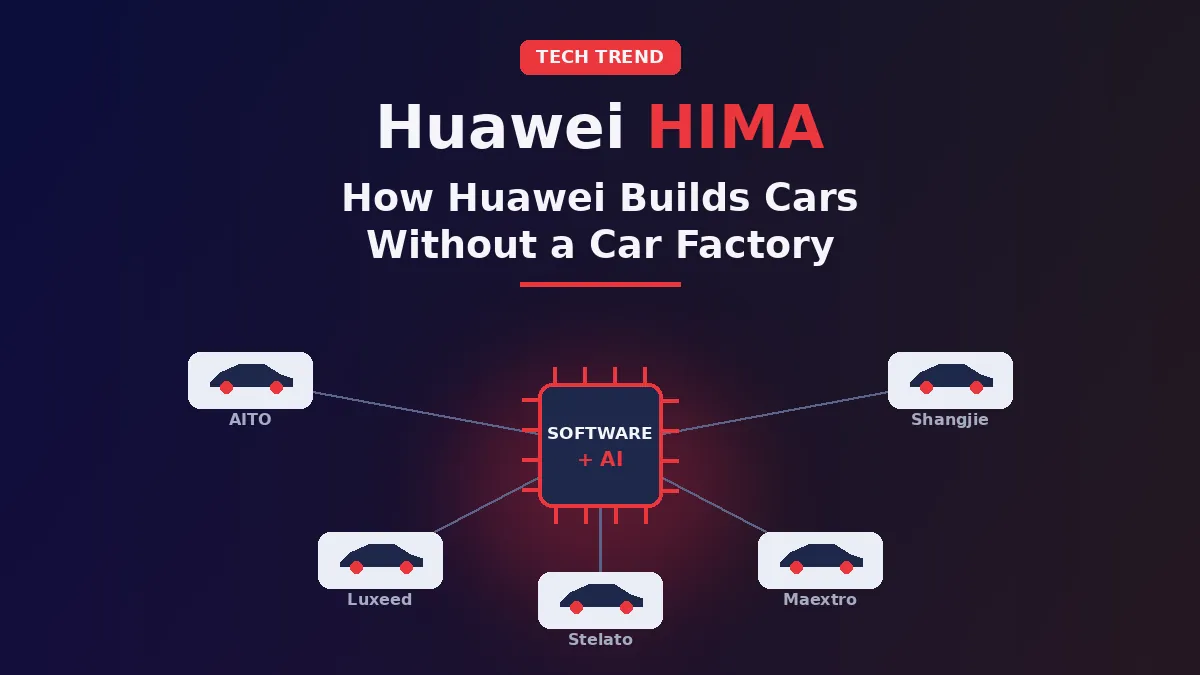
- HIMA has five brands: AITO (Seres), Luxeed (Chery), Stelato (BAIC), Maextro (JAC) and Shangjie (SAIC).
- HIMA passed 1 million deliveries in October 2025 and more than 1.56 million by September 2026.
- Prices range from about 160,000 yuan to 1 million yuan, covering mid-range to ultra-luxury buyers.
- Sales have slowed in recent months of 2026, and the AITO partnership is being reshaped.
What Is Huawei HIMA?
Huawei HIMA (in Chinese, 鸿蒙智行) is short for Harmony Intelligent Mobility Alliance. The name comes from HarmonyOS, Huawei’s own operating system that runs on its phones, tablets and watches.
In simple words, HIMA is a team-up between Huawei and traditional Chinese carmakers. The carmaker owns the factory, handles production and holds the vehicle licence. Huawei brings the “brain” of the car: the smart cockpit, the self-driving software, key electric parts, product planning, and its huge retail network of Huawei stores. The car carries the partner’s brand name, but buyers see it as a “Huawei car”.
Think of it like this: the carmaker builds the body, and Huawei builds the mind.
Why Doesn’t Huawei Just Build Its Own Cars?
This is the question most people ask. There are several clear reasons.
1. A public promise
Huawei founder Ren Zhengfei signed internal statements in 2020, 2021 and 2023 saying that Huawei will not make cars. Breaking this promise would damage trust with the carmakers that buy Huawei technology.
2. Car factories are expensive and risky
Building cars needs huge factories, large teams of workers and years of investment. Profit margins on car manufacturing are thin, especially in China’s ongoing price war. Software and technology, on the other hand, can be sold to many carmakers at once with much higher margins.
3. Scale through partners
By working with five different automakers, Huawei can launch many models across many price levels at the same time. No single new carmaker could do that so quickly on its own.
4. Keeping customers, not competitors
If Huawei made its own cars, other carmakers would see it as a rival and stop buying its technology. Staying a technology partner keeps the door open to the whole industry.
The Three Ways Huawei Works With Carmakers
Huawei does not use one single model. It works with carmakers at three different levels, from light to deep involvement.
| Model | What Huawei does | Example |
|---|---|---|
| 1. Parts supplier | Sells individual components such as motors, lidar sensors or chips, like any normal supplier. | Many Chinese carmakers |
| 2. Huawei Inside (HI) | Provides a complete package of smart car technology. The carmaker still leads design, sales and branding. | Avatr (Changan) |
| 3. HIMA (deepest level) | Joins product planning, design, quality control, marketing and sales. Cars are sold in Huawei stores and carry the HIMA identity. | AITO, Luxeed, Stelato, Maextro, Shangjie |
HIMA is the most powerful of the three because Huawei controls almost the whole customer experience, from the showroom to the software updates, while its partner handles the heavy manufacturing work.
All Huawei HIMA Car Brands Explained
| HIMA brand | Partner carmaker | Main models | Positioning |
|---|---|---|---|
| AITO | Seres | M5, M6, M7, M8, M9 | Premium family SUVs, HIMA’s biggest seller |
| Luxeed | Chery | S7, R7, V9, RX | Stylish sedans, SUVs and an MPV |
| Stelato | BAIC | S9, S9T, G9, V8 | Executive sedans and wagons |
| Maextro | JAC | S800, V800, V680 | Ultra-luxury flagship, rival to Maybach |
| Shangjie | SAIC | H5, Z7, Z7T | More affordable entry into HIMA |
AITO: the brand that started it all
AITO was the first HIMA brand, with its first model, the M5, arriving in 2021. Its big success is the AITO M9, a large luxury SUV that delivered more than 250,000 units in about 21 months and set a sales record for cars priced above 500,000 yuan in China. The AITO M8 also crossed 100,000 deliveries by September 2025. In 2024, Huawei transferred the AITO trademark to Seres.
Luxeed: Huawei’s style statement
Luxeed, built with Chery, focuses on sleek design. The S7 sedan starts from around 229,800 yuan and the R7 SUV from around 249,800 yuan. The new Luxeed V9 MPV passed 20,000 deliveries quickly in 2026.
Stelato: business-class comfort
Stelato, built with BAIC, targets executives who want a quiet, comfortable ride. The new Stelato G9 received more than 5,000 firm orders within 24 hours of launch in 2026.
Maextro: the ultra-luxury flagship
Maextro, built with JAC, is HIMA’s most expensive brand. The Maextro S800 sedan sits in the 700,000+ yuan luxury segment and is aimed at buyers who would otherwise consider a Mercedes-Maybach or Rolls-Royce.
Shangjie: the newest and most affordable
Shangjie, built with SAIC, is the newest HIMA brand. Its H5 starts from around 159,800 yuan, making it the most affordable way to get a Huawei-powered car.
The Technology Inside Huawei Cars
What makes a HIMA car feel different is not the engine or the body. It is Huawei’s technology stack.
- HarmonyOS cockpit: the car runs the same operating system as Huawei phones. Apps, music, navigation and calls move smoothly from phone to car screen.
- Qiankun ADS: Huawei’s advanced driver-assistance system uses lidar, radar and cameras to support highway driving, city navigation and automatic parking. The latest version can reportedly detect small objects on the road from more than 100 meters away.
- Electric drive parts: Huawei supplies motors and power systems for several models.
- Huge AI computing power: Huawei is investing heavily in cloud computing to train its driving AI, with a reported 18 billion yuan intelligent-driving budget for 2026.
- Over-the-air updates: cars receive new features through software updates, just like a smartphone.
Huawei HIMA Sales in 2026
HIMA has grown very fast, but 2026 has brought its first real slowdown.
| Period | Deliveries / Milestone |
|---|---|
| October 2025 | Passed 1 million total deliveries |
| May 2026 | 46,122 vehicles |
| July 2026 | 45,046 vehicles |
| August 2026 | 42,101 vehicles (total passed 1.52 million) |
| September 2026 | 37,490 vehicles, down about 29% year-on-year |
| January–September 2026 | 367,229 vehicles, up about 5% year-on-year |
By the end of September 2026, HIMA’s total deliveries had passed 1.56 million vehicles. However, September was the fourth month in a row with lower sales than the same month last year. Part of the reason is tough competition from Xiaomi, Li Auto, Tesla and BYD in the premium SUV market, and falling sales of the AITO M8.
A Big Change: The New AITO–Seres Model
In September 2026, Huawei and Seres announced that AITO would explore a new way of working, with Seres taking the lead and Huawei moving to a supporting role. AITO stays inside HIMA, and the other four brands are not affected. This is a major moment because AITO has been HIMA’s top seller. It shows that partners who grow strong may want more control over their own brand.
Huawei HIMA vs Xiaomi: Two Different Paths
Huawei and Xiaomi are both phone companies that entered the car business, but they took opposite routes.
| Point | Huawei HIMA | Xiaomi Auto |
|---|---|---|
| Own car factory | No | Yes |
| Who builds the car | Partner carmakers | Xiaomi itself |
| Number of brands | Five | One (Xiaomi) |
| Price range | About 160,000 to 1 million yuan | Mainly 200,000 to 550,000 yuan |
| Operating system | HarmonyOS | HyperOS |
| Main strength | Advanced driving AI and many models | Full control and strong single brand |
Huawei’s model is lighter and spreads its technology widely. Xiaomi’s model gives it full control over quality and design but needs much more investment.
Challenges Facing Huawei HIMA
- Slowing sales: deliveries have dropped year-on-year for several months in 2026.
- Partner tension: successful partners like Seres may want more independence.
- Brand confusion: with five brands and many models, some buyers find it hard to tell them apart.
- US restrictions: US rules on Chinese connected-car software and hardware, starting with model year 2027, block Huawei technology from the American market.
- Limited global presence: HIMA has no official sales network in Europe yet, and most sales still come from China.
Can You Buy a Huawei Car in Pakistan?
As of October 2026, HIMA cars such as AITO, Luxeed or Maextro are not officially sold in Pakistan, and there is no Huawei car dealer or service centre in the country. Some private importers may bring them from China, but buyers face real risks: the Chinese warranty usually does not apply abroad, the HarmonyOS system is designed for Chinese apps and services, and spare parts can be hard to find. Anyone interested should wait for an official launch in the region.
Why Huawei HIMA Matters for the Future of Cars
Huawei HIMA shows that in the age of electric and smart cars, the company that controls the software and AI can be just as powerful as the company that owns the factory. Huawei has proved that a tech brand can sell more than 1.5 million cars without bending a single piece of metal itself.
If this model continues to work, more carmakers around the world may choose to partner with tech companies instead of building everything on their own. At the same time, the 2026 slowdown and the AITO changes show that this model also has limits. The next year will show whether HIMA can return to strong growth.
Frequently Asked Questions
What does HIMA stand for?
HIMA stands for Harmony Intelligent Mobility Alliance. It is a car alliance led by Huawei, named after its HarmonyOS operating system.
Does Huawei make its own cars?
No. Huawei does not manufacture cars. Partner automakers build the cars in their own factories, while Huawei provides software, driving AI, design support and sales channels.
Which car brands are part of Huawei HIMA?
HIMA has five brands: AITO (with Seres), Luxeed (with Chery), Stelato (with BAIC), Maextro (with JAC) and Shangjie (with SAIC).
Is Avatr a Huawei HIMA brand?
No. Avatr, from Changan, uses Huawei technology through the “Huawei Inside” model, but it is not part of HIMA.
What is the best-selling Huawei HIMA car?
The AITO M9 is one of HIMA’s most successful models, with more than 250,000 deliveries in about 21 months.
How many cars has Huawei HIMA sold?
HIMA passed 1.56 million total deliveries by September 2026. In the first nine months of 2026, it delivered 367,229 vehicles.
What is the most expensive Huawei HIMA car?
The Maextro S800 is HIMA’s flagship luxury sedan, priced in the 700,000 yuan and above segment.
What is Qiankun ADS?
Qiankun ADS is Huawei’s advanced driver-assistance system. It uses lidar, cameras and radar to help with highway driving, city navigation and parking.
Are Huawei cars sold outside China?
HIMA has no official sales network outside China yet. Some independent importers sell Huawei-powered cars in Europe, but without the official Chinese warranty.
Are Huawei HIMA cars available in Pakistan?
No. As of October 2026, Huawei HIMA cars are not officially sold in Pakistan. Private imports are possible but come with warranty, software and service risks.